
It measures 41.5 millimeters tall and 21.5 millimeters across, roughly the length of a thumb. It weighs just under 39 grams and does not gleam nor announce itself. But this black stone cylinder seal is approximately 4,500 years old, and it belongs to the earliest chapter of organized human civilization. Created around 2500 BC in a region spanning what is now Syria and southeastern Turkey, it was made during the same centuries that saw the construction of the Great Pyramid of Giza. It predates the alphabet, predates coined money, predates the Trojan War by a thousand years. If the span of recorded human history were compressed into a single day, this seal was made before dawn.
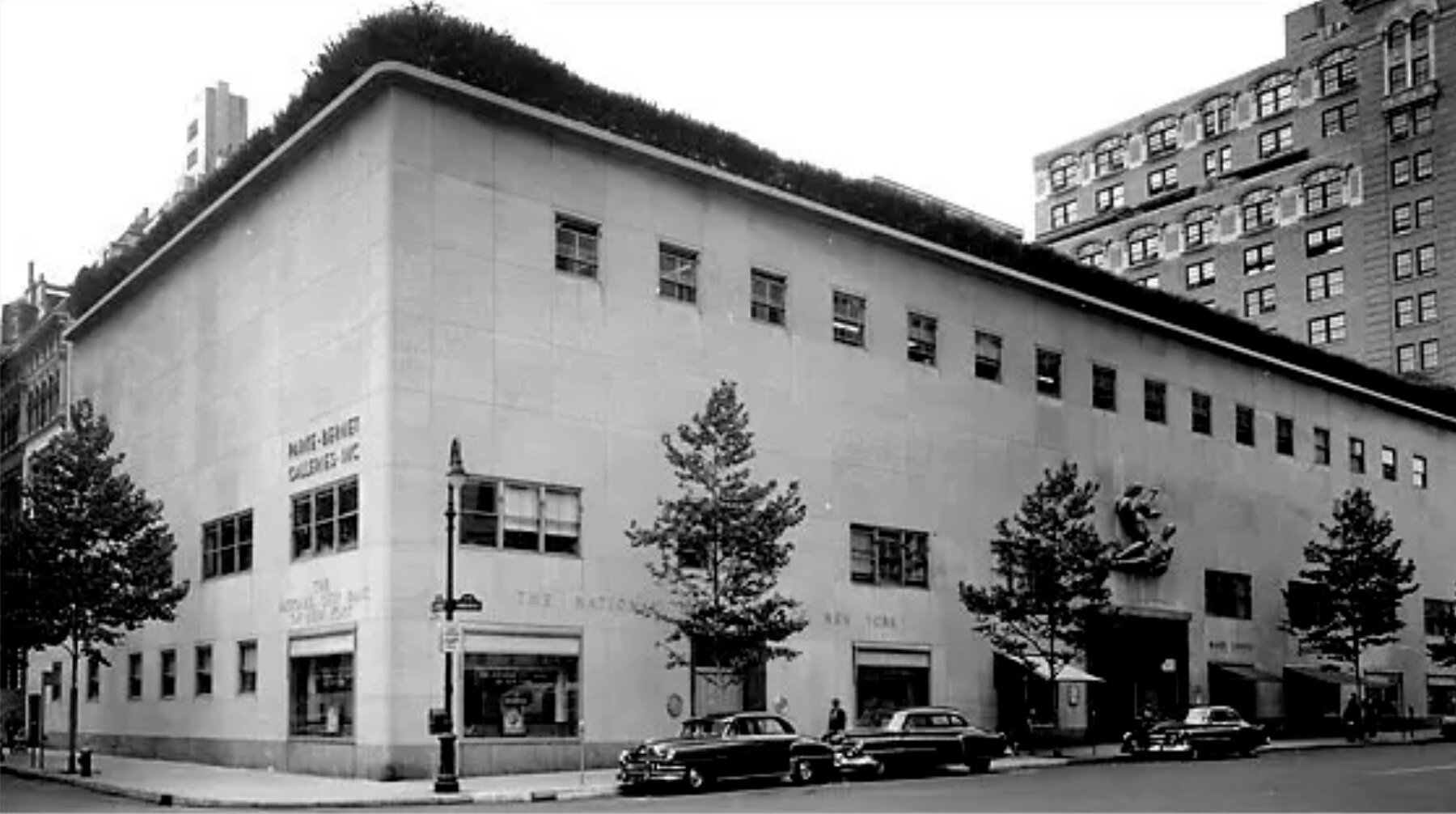
It sold at Parke-Bernet for more than $25,000, an outcome driven by competitive bidding from collectors who recognized exactly what it was: an authenticated, museum-quality object from the deep past, accompanied by scholarly documentation of the highest order.
The oldest form of identity
By 2500 BC, cities across the Near East were thriving centers of trade and administration. Writing had existed for a thousand years. Commerce stretched from Afghanistan to the Mediterranean. Within this world, the cylinder seal served as signature, contract, and lock in one. Rolled across wet clay, it left a continuous frieze of imagery that authenticated tablets, sealed storage jars, and secured storeroom doors. To forge one was a serious crime and to lose one was a personal crisis.
The seal was simultaneously a legal instrument, a personal ornament worn on the body, and a portable work of art. The material of the stone, the sophistication of the engraving, and the complexity of the imagery all broadcast the social standing of the owner, much as a signet ring would in later Western tradition. Unlike monumental architecture or large-scale sculpture, a seal was made for one person’s hand, one person’s identity. When you hold this cylinder seal, you hold something that was held in exactly the same way by someone who lived before the rise of Greece, before the invention of the wheel in most of the world.
What the seal depicts
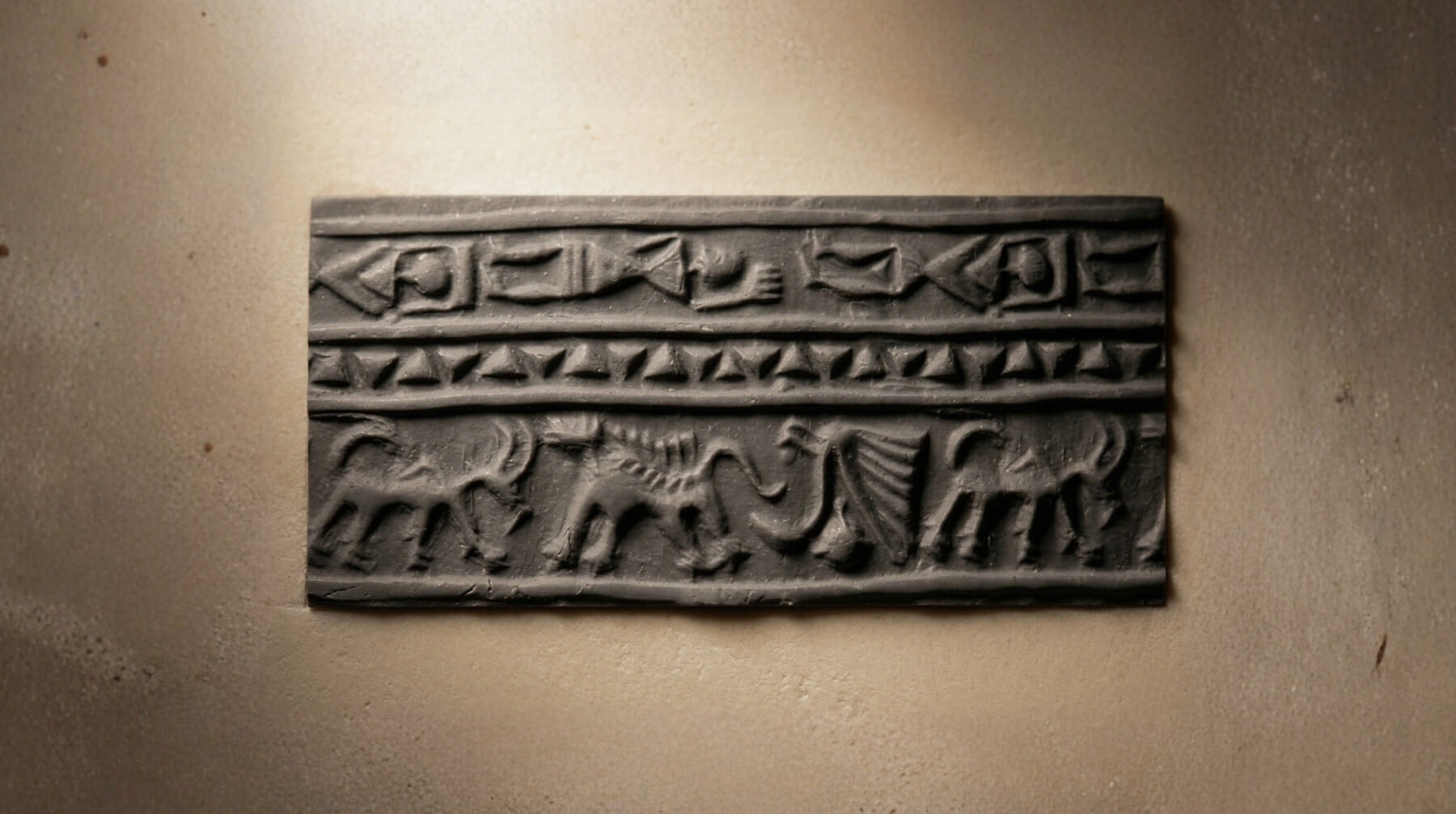
The engraving is divided into two horizontal registers by a decorative band of two parallel lines separated by alternately inverted triangles. In the upper register, two human figures appear in profile. The first, apparently male, stands with one arm raised high and the other extended at the waist, a gesture that across the ancient Near East typically signals supplication or ritual participation. The second, apparently female, holds an oblong object above her head with both hands, suggesting an offering or the elevation of a sacred object. The posture is among the most recognizable in ancient Near Eastern iconography, recurring on votive reliefs and royal monuments throughout the region.
The lower register is more richly populated. Two quadrupeds face each other: one, clearly horned, has lowered its head; the other, with raised head and distinctive back markings, likely represents a boar. A bird appears in a tête-bêche orientation, inverted relative to the animals, with an additional element placed between its head and wing-tip. The pairing of human and animal registers suggests deliberate juxtaposition: the social world above, the natural or supernatural world below. As the accompanying scholarly note observes, the composition is unusual. It does not conform to the standard presentation or contest scenes of later Mesopotamian glyptic, but is instead something more localized and distinctive, rooted in the specific visual traditions of Early Bronze Age Syria or Anatolia.
The engraver who carved this scene worked without magnification, in mirror image, on a curved surface measured in millimeters, using hand-held tools. Every cut was irreversible. This was one of the most technically demanding art forms ever practiced, and the confidence visible here places it within the uppermost tier of Early Bronze Age craftsmanship. This lot is accompanied by a museum-quality modern impression that allows the full engraved scene to be read as its maker intended: in relief, unrolled into a continuous frieze.
Authenticated by a giant of the field
The seal was acquired by a British collector between 1990 and 1993, during which time it was examined and formally documented by Professor Wilfred George Lambert of the University of Birmingham. A typed scholarly note, signed by Lambert in 1992, accompanies the lot, providing precise physical descriptions, geographic and chronological attribution, and his assessment of the object as unusual and impressive.
Lambert’s name carries exceptional weight. Elected a Fellow of the British Academy in 1971, he was widely regarded as one of the foremost Assyriologists of the twentieth century. His published works include Babylonian Wisdom Literature, authoritative editions of the Enuma Elish, and Ancient Near Eastern Seals in Birmingham Collections, a reference work in glyptic studies. He was one of the very few scholars capable of reading the difficult inscriptions found on cylinder seals, and his standards when authenticating objects were legendary. Lambert passed away in November 2011. The pool of objects bearing his direct scholarly endorsement is permanently closed.
A mark that endures
Cylinder seals survive in numbers, but the vast majority reside in museum collections, accessioned from archaeological excavations. The number combining genuine Early Bronze Age antiquity, documented provenance, formal scholarly authentication, and high artistic quality that remain available for private acquisition is finite and shrinking. This seal, dated to approximately 2500 BC, attributed to Syria or Anatolia, displaying distinctive and iconographically rich imagery, and endorsed by one of the twentieth century’s greatest authorities, is an uncommon convergence of all four.
Competitive bidding confirmed what the Lambert note had quietly established decades earlier. And yet this authenticated object from the age of the pyramids, reviewed and documented by a Fellow of the British Academy, sold for less than many modern luxury goods that will not survive a single generation, let alone forty-five centuries. These images, carved into black stone before the invention of the alphabet, endure. The seal was made to leave a mark, and it continues to do so.