
A painting arrives. It is unsigned, or signed ambiguously. It has been in a family for generations, or it was purchased decades ago from a dealer who is no longer in business. The frame is old. The canvas looks old. The subject matter and technique suggest a particular artist, a particular school, a particular century. But suggesting is not the same as proving. The question that must now be answered, rigorously and without sentiment, is whether this painting is what it appears to be. That question launches a process that can take weeks, months, or in complex cases, years. It involves archivists, conservators, art historians, scientists, and sometimes lawyers. It is part detective work, part material science, and part connoisseurship. And it almost always begins with paper.
Following the paper
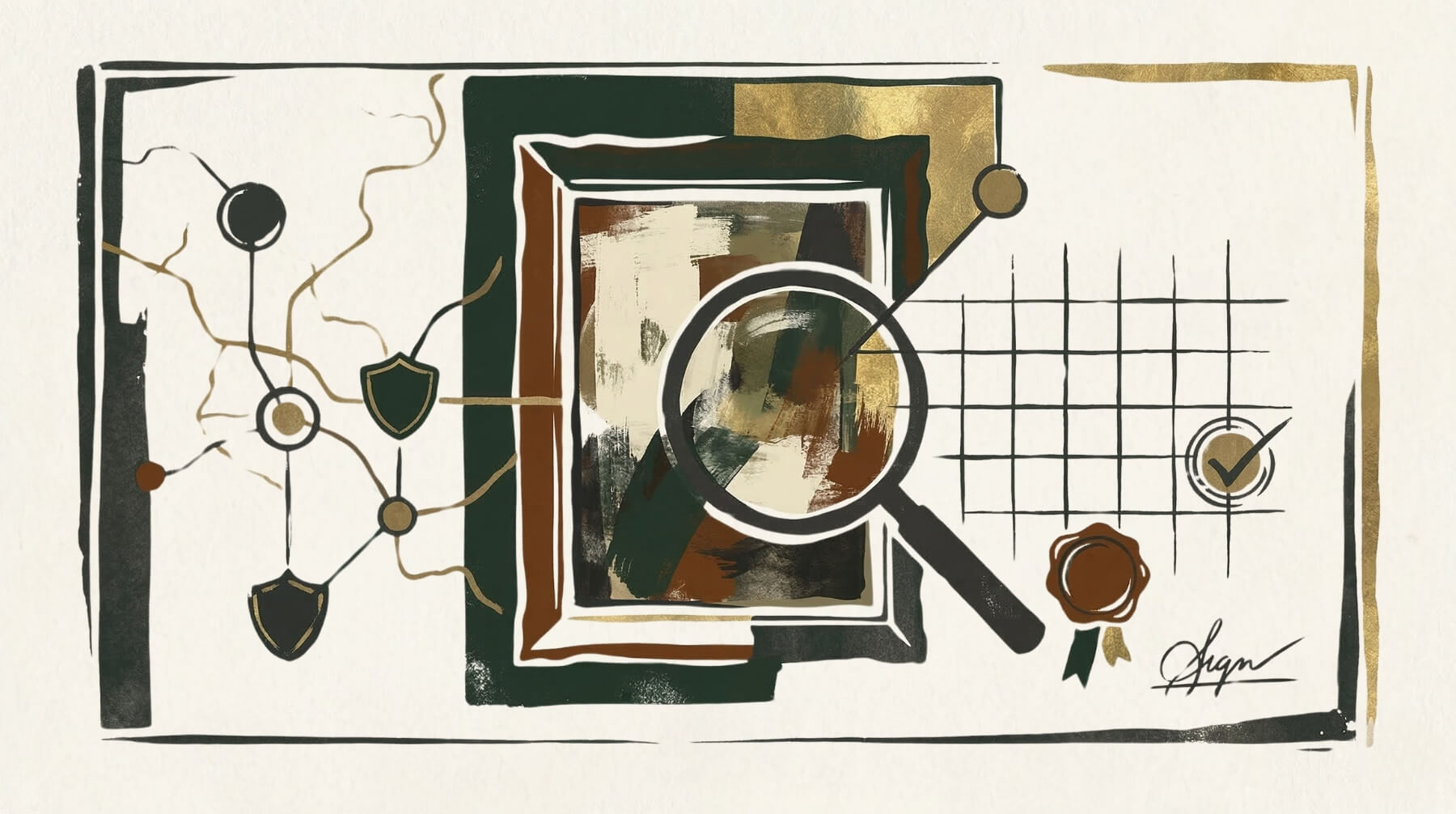
The first and most fundamental question in any authentication is provenance: where has this painting been? A complete provenance is an unbroken chain of documented ownership from the artist’s studio to the present day. In practice, such chains are rare. Gaps are normal. But the quality, specificity, and verifiability of whatever documentation does exist is the foundation on which everything else rests.
The paper trail can include bills of sale, auction records, gallery invoices, insurance documents, exhibition catalogs, estate inventories, customs declarations, shipping receipts, and personal correspondence. Each document anchors the painting at a specific place and time. A receipt from a Paris dealer in 1847 tells us the painting existed in 1847, was in Paris, and was considered valuable enough to sell. An entry in an exhibition catalog tells us it was displayed publicly and attributed to a specific artist by the organizers of that show. A mention in a private letter tells us someone saw it, described it, and placed it in a particular collection.
Provenance researchers work in archives, libraries, auction house records, museum registries, and the increasingly digitized databases that index them. The Getty Provenance Index, the International Foundation for Art Research, and the archives of major auction houses are among the most important resources. For European paintings, church records, aristocratic inventories, and the stock books of historical dealers can fill gaps that no other source addresses. For American paintings, estate records, early exhibition catalogs from institutions like the National Academy of Design, and the files of long-established galleries are essential.
Critically, provenance research also serves a legal and ethical function. For any painting that changed hands in Europe between 1933 and 1945, the question of whether it was looted, confiscated, or sold under duress during the Nazi era must be thoroughly investigated. Museums, auction houses, and responsible dealers now routinely screen works against databases of stolen and looted art maintained by organizations such as the Art Loss Register. A gap in provenance during the war years does not automatically disqualify a painting, but it demands explanation and due diligence.
Connoisseurship and comparative analysis
Before any scientific instrument is deployed, a painting is examined by specialists whose expertise is, at its core, visual. Connoisseurship is the trained ability to evaluate a painting’s authorship based on its formal qualities: the handling of paint, the treatment of light and shadow, the construction of forms, the rhythm of brushwork, the palette, and the compositional instincts that distinguish one artist’s hand from another’s. It is sometimes dismissed as subjective, and it is true that connoisseurial opinions have been wrong. But it remains the first and most efficient filter in the authentication process.
A specialist examining a painting attributed to, say, a Dutch Golden Age master will compare it against the artist’s known body of work, looking for consistency in technique, composition, and subject matter. They will consult the catalogue raisonné, the comprehensive scholarly catalog of all known works by a given artist, to determine whether this painting has been previously recorded, illustrated, or discussed. If it has, the authentication gains a critical point of support. If it has not, the specialist must determine whether it represents a genuine but previously unknown work, a workshop production, a period copy, or a later imitation.
The back of a painting often reveals as much as the front. Labels from galleries, auction houses, and exhibitions are frequently affixed to the stretcher or frame. Old inventory numbers, customs stamps, and handwritten inscriptions can provide datable evidence of where the painting has been. A gallery sticker from a firm that closed in 1910 tells us the painting was handled before 1910. A customs stamp from a port of entry can establish when it crossed a border. These marks are the physical residue of the paper trail, and experienced specialists read them fluently.
Scientific analysis under the surface
Where the eye and the archive reach their limits, science takes over. The past several decades have seen an expansion of analytical techniques that can examine the material composition of a painting with extraordinary precision, often without touching it. These methods do not, by themselves, authenticate a painting. What they can do, definitively, is disqualify one. A single anachronistic material is enough to prove a painting is not what it claims to be.
X-radiography and infrared reflectography reveal what lies beneath the visible paint surface: underdrawings, compositional changes (known as pentimenti), earlier paint layers, and evidence of restoration or overpainting. Genuine old paintings almost always show pentimenti, because artists change their minds as they work. Copies and forgeries, which are reproducing a finished image, typically do not. The presence of an underdrawing that departs from the final composition is strong evidence of an original working process.
Pigment analysis, conducted through techniques such as X-ray fluorescence spectroscopy and Raman spectroscopy, identifies the chemical composition of the paint itself. This matters because many pigments have known dates of invention or commercial availability. Zinc white, for instance, was not widely used before the 1830s. Titanium white was not available before 1920. If a painting said to date from 1780 contains titanium white, the attribution collapses. The same logic applies to certain synthetic pigments, binding media, and canvas types that can be dated by their manufacturing processes.
For paintings on wooden panels, dendrochronology provides one of the most precise dating tools available. By analyzing the tree-ring patterns in the wood, scientists can determine when the tree was felled, and in many cases, where it grew. Northern European panel painters of the fifteenth and sixteenth centuries frequently used Baltic oak imported through specific trade routes. If a panel claimed to be Flemish turns out to be made from Italian poplar, or if the wood was felled decades after the supposed date of painting, the discrepancy becomes a serious obstacle to authentication.
Craquelure, the network of fine cracks that develops in paint over time, is another source of evidence. Genuine age-related craquelure has a characteristic depth, pattern, and distribution that is extremely difficult to replicate artificially. Researchers have cataloged craquelure patterns by region and period, and machine-learning tools are now being used to detect inconsistencies that might escape the unaided eye.
Convergence, not certainty
No single piece of evidence authenticates a painting. Authentication is a process of convergence: documentary evidence supports a visual attribution, which is consistent with material analysis, which is compatible with the known practices of the artist and the period. When all lines of evidence point in the same direction, the case for authenticity strengthens. When they diverge, doubt enters.
It is important to note that even the most rigorous authentication is, technically, an opinion. Scholarly consensus can shift. New information can emerge. A painting accepted for decades can be downgraded to a workshop production or a later copy. Conversely, a painting long dismissed as minor can be re-examined and elevated. The history of art attribution is full of such reversals. The process is not infallible. But it is, when conducted with proper rigor, the best means available for determining whether a painting is what it claims to be.
For collectors, the practical lesson is straightforward: documentation matters. Every receipt, every letter, every exhibition catalog, every photograph of a painting hanging on a wall in 1923 adds a link to the chain. Provenance is not merely an administrative formality. It is the memory of an object, and like all memory, it must be actively preserved. The paper trail that authenticates a 200-year-old painting today was built, piece by piece, by the people who bought it, sold it, exhibited it, insured it, and passed it on. The trail you create for what you own now will serve the same purpose for who comes after you.