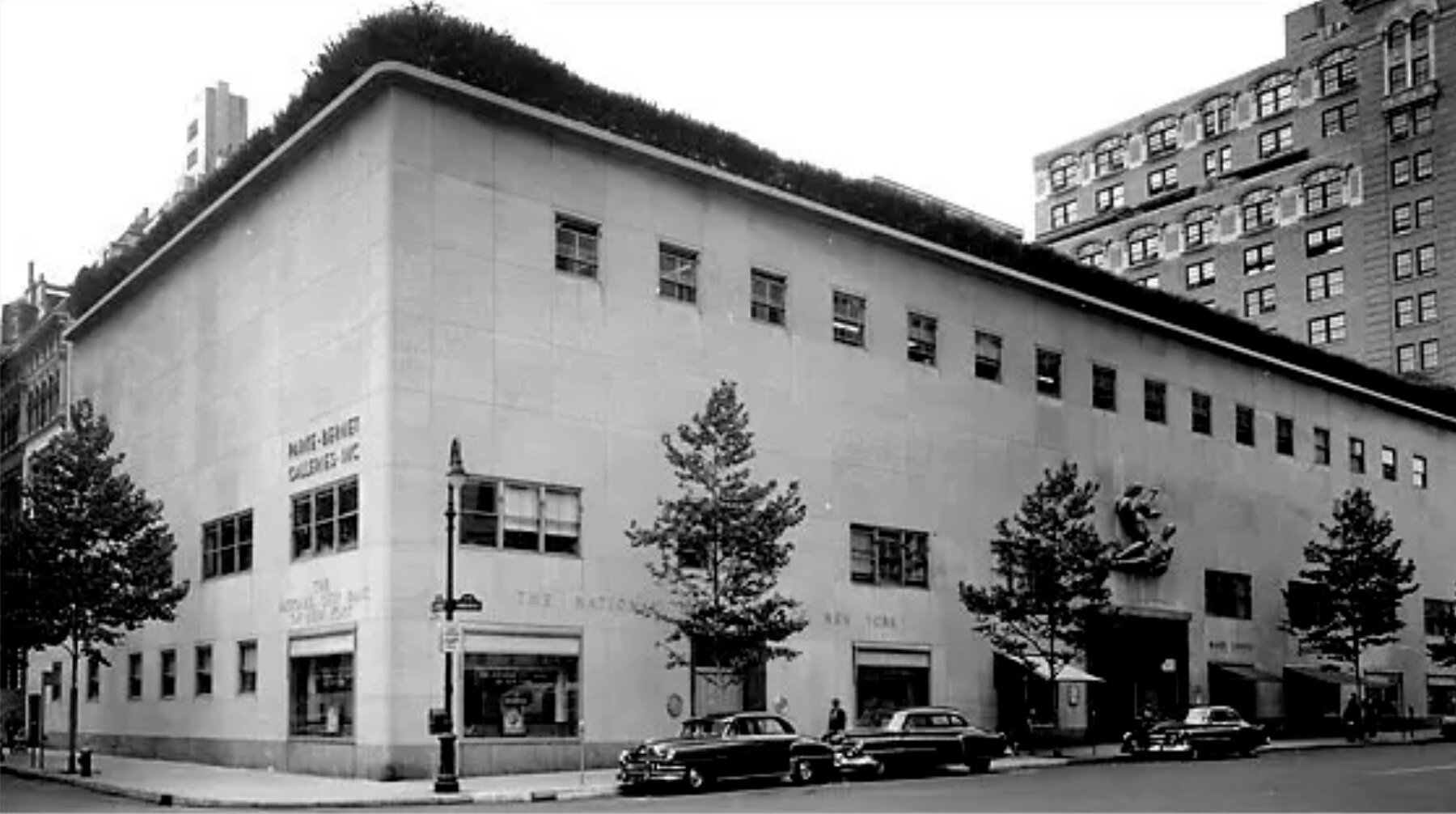

In November 1937, forty employees of the American Art Association walked out and started their own auction house. They called it Parke-Bernet. Within a decade, it was the most important auction room in the country. By 1949, it had moved into a purpose-built headquarters at 980 Madison Avenue, a building the New York Times hailed as a new departure in commercial architecture, with ten galleries, a 2,000-seat auditorium, and a stage modeled on Broadway. For the next fifteen years, Parke-Bernet was the beating heart of the American art market: the place where collections were made and unmade, where records were set, where Manhattan’s cultural elite gathered under one roof to compete for the extraordinary.
In 1964, Sotheby’s of London purchased a controlling stake for $1.5 million. The name was hyphenated, then gradually absorbed, then dropped. The Madison Avenue building was vacated in 1987. The name faded from public memory. For most people in the art world today, Parke-Bernet is a historical footnote: something you encounter in old catalog entries, or in the provenance line of a painting that last traded in 1962.
We believe that is a mistake worth correcting.•
What Was Lost
When Parke-Bernet was absorbed into Sotheby’s, what disappeared was not merely a brand. It was a particular vision of what an American auction house could be: specialist-led, connoisseurial, and accountable to the objects on the block rather than to the quarterly expectations of a global parent company. The founders of Parke-Bernet were not financiers or media executives. They were people who had spent their careers in the rooms, handling objects, building catalogs, and developing the professional standards that would define American auctioneering for the rest of the century.
Under their direction, Parke-Bernet professionalized the auction business in ways that are now taken for granted: rigorous cataloging, advance distribution of catalogs to attract international buyers, detailed provenance research, and a transparency in process that the European houses of the period did not always match. Average lot values rose sharply during Parke-Bernet’s independent years. Museums began acquiring at auction, using the new tax deductions for art donations introduced in the 1950s to build their collections. The American art market matured, and Parke-Bernet was a primary reason why.
The consolidation that followed was understandable in its moment. Sotheby’s wanted access to the American market. Parke-Bernet’s founding generation had died or retired. The deal made financial sense. But the effect, over time, was the reduction of the American auction landscape to a small number of very large, very similar international operations. The market became more efficient. It also became less personal, less specialist-driven, and less accountable to the communities of collectors it was supposed to serve.
A Market Transformed
The collectibles and fine art market in 2026 bears almost no resemblance to the one Parke-Bernet left behind. The global collectibles market is now valued in the hundreds of billions of dollars. The collectibles auction segment alone is projected to approach $47 billion by the early 2030s. Categories that barely existed a generation ago now command serious money and serious attention: vintage watches, rare sneakers, trading cards, space memorabilia, early technology, design furniture, and a continually expanding universe of objects that collectors value for their rarity, craftsmanship, and cultural resonance.
The collector base has transformed in parallel. Over half of active collectors in the United States are now between 25 and 45. They are digitally fluent. They buy from their phones. They discover objects through social media, through live-streamed auctions, through algorithmic recommendations. Millennials and Gen Z are not abandoning the pursuit of authentic, tangible objects; they are accelerating it, drawn by a combination of aesthetic conviction, investment logic, and a rejection of disposable mass production. The demand is real, it is growing, and it is not being adequately served by institutions built for a different era.
At the same time, the upper end of the market remains robust. The second-hand luxury sector is projected to nearly double over the next several years. Tangible assets, including art, jewelry, watches, and rare objects, have demonstrated counter-cyclical resilience through periods of equity market volatility and currency instability. For high-net-worth collectors, authenticated rare assets are not just passion purchases; they are a component of a diversified wealth strategy. The appetite is there. What is often missing is the institution worthy of the trust that appetite demands.
The Crisis Nobody Wants to Name
Here is the uncomfortable reality of the current market: the tools that make objects easier to discover, photograph, and sell have also made them easier to misrepresent. Generative AI can now produce images of objects that do not exist, descriptions that sound authoritative but are fabricated, and provenance narratives that are plausible but invented. Deepfakes are not a theoretical threat to the art market; they are an operational one. The more the market moves online, the more the gap between what a buyer can see and what a buyer can verify widens.
This is not a technology problem. It is a trust problem. And trust, in the end, cannot be automated. It is built by specialists who stake their reputations on every lot they catalog. It is built by institutions that stand behind their attributions, their condition reports, and their provenance research. It is built by organizations that understand that a buyer is not just purchasing an object; they are purchasing confidence that the object is what it is represented to be. The auction house exists, at its core, to provide that confidence. When it fails to do so, or when it subordinates expertise to volume, it forfeits the only thing that distinguishes it from a marketplace.
The rise of authentication services, third-party grading, and blockchain-based provenance tracking all point in the same direction: the market is hungry for mechanisms of trust. But none of these tools replaces the informed human judgment that sits at the center of the process. An algorithm can flag an inconsistency. It cannot hold an object in its hands and know. A grading service can assign a number. It cannot write a catalog entry that situates an object within the history of its maker, its period, and its tradition. These are things that require knowledge, experience, and a willingness to be accountable. They require an institution.
Why Parke-Bernet, and Why Now
We revived Parke-Bernet because we believe the market needs what Parke-Bernet was built to provide: expert curation, rigorous authentication, and a commitment to the object above all else. Not as a nostalgic exercise, but as a response to a set of conditions that did not exist when the name was retired. The market is larger, faster, more global, and more accessible than it has ever been. It is also more exposed to fraud, misattribution, and the erosion of standards that comes with unchecked scale.
The modern Parke-Bernet is built for this moment. We combine the specialist depth and connoisseurial rigor that defined the original house with the technology, accessibility, and format innovation that today’s collectors expect. Multi-format sales, from traditional live auctions to sealed-bid and flash formats, give consignors and buyers flexibility without sacrificing curatorial quality. AI-assisted analysis supports our specialists; it does not replace them. Smart proxy bidding, real-time collection tracking, and mobile-first tools put the power of a full-service auction house in a collector’s pocket. But behind every lot, behind every estimate, behind every catalog entry, there is a human specialist who has examined the object, researched its history, and is prepared to stand behind the assessment.
This is not the auction house reimagined as a technology platform. It is the auction house reimagined as what it should have been all along: a place where expertise meets access, where trust is earned object by object, and where the growing community of collectors who care about authenticity, quality, and the stories behind what they own can find an institution that cares about those things as much as they do.
The Name on the Door
In 1937, forty people bet their careers on the conviction that America deserved a great auction house, run by specialists, accountable to the objects, and open to anyone who walked through the door. They built it. It became the largest in the country. It set records. It shaped taste. It made the American art market what it is. Then it was sold, absorbed, and forgotten.
The conditions that made Parke-Bernet necessary in 1937 have returned, in amplified form, in 2026. The market is bigger. The risks are greater. The need for trusted, specialist-led institutions is more acute than it has been in decades. And the collectors who will define the next generation of the market are looking for exactly what Parke-Bernet was founded to provide: a house that knows what it is selling, says what it knows, and means what it says.
The name is back. The standards are back. The future starts here.